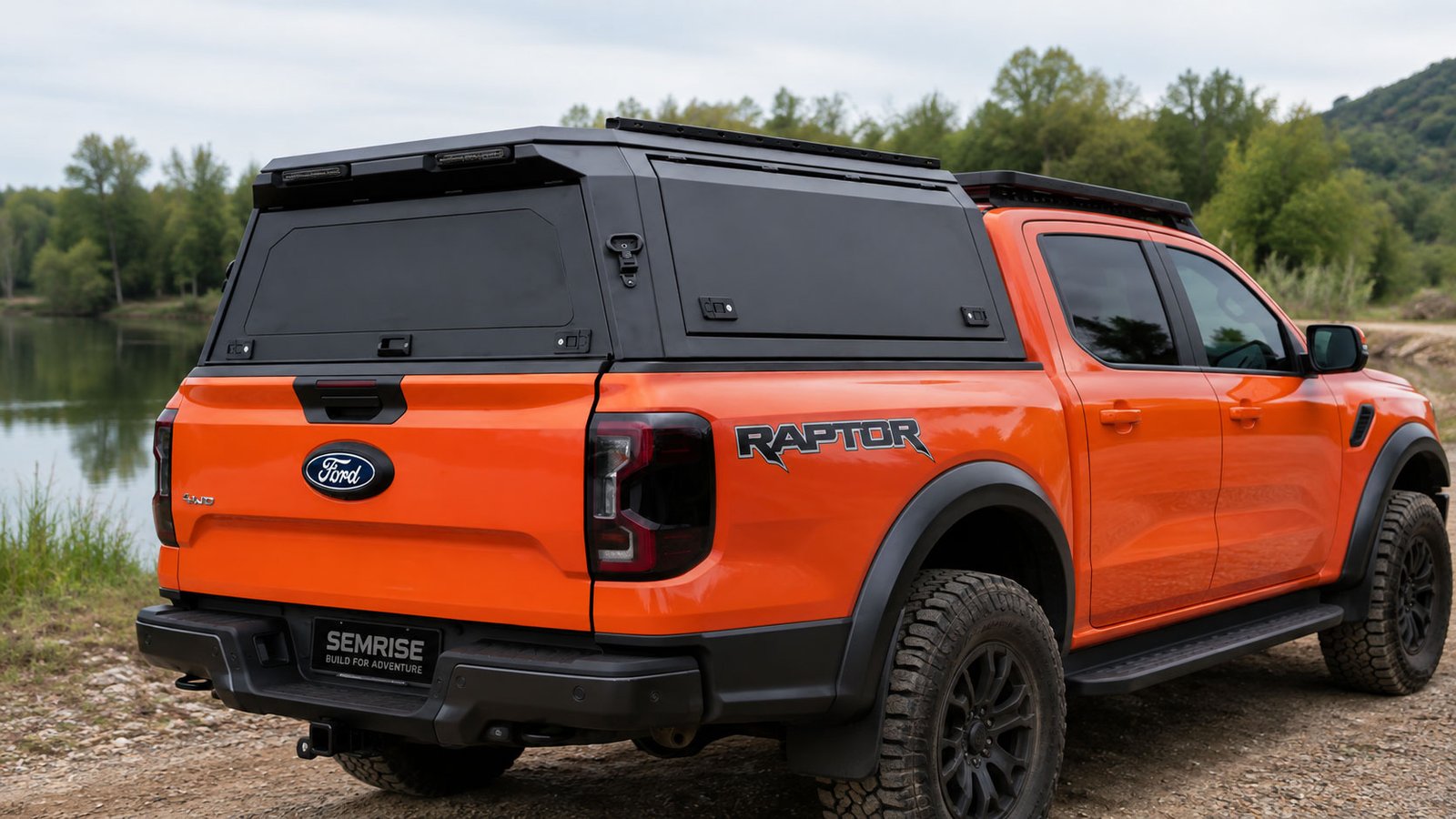
Inside SEMRISE Modular Aluminum Truck Canopies: From Packed Modules to Vehicle Fitment
A modular aluminum truck canopy does not become a finished vehicle accessory at the moment its panels leave the factory. It must be packed as an identifiable set of components, assembled in the correct sequence, checked as a complete enclosure and then matched to a specific pickup application.
That distinction matters to importers, distributors and private-label brands. Product design affects more than appearance: it influences export handling, installer workflow, door alignment, sealing, electrical integration, roof-load conditions and after-sales support.
This article looks inside the SEMRISE modular aluminum canopy range and explains how the product moves from packed modules to application-specific vehicle fitment. It also compares the double-light 8000SE-C and single-light 8000SE-X configurations.
Product scope: Available specifications and vehicle applications must be confirmed for the exact project. A fitment record or internal test supports product review, but it does not create universal compatibility or performance under every condition.
What Is a Modular Aluminum Truck Canopy?
A modular truck canopy is supplied as multiple structural and functional sections rather than as one permanently assembled shell. The exact panel and hardware arrangement depends on the design, but the completed system normally brings together the roof, side structures, front and rear sections, access doors, hinges, locks, seals, glass, lights and mounting hardware.
Modular truck caps are already an established product direction. Current systems from manufacturers such as Westin and LEER describe multi-piece construction, standard-tool assembly and no-drill installation for specified vehicles (Westin EXP Truck Cap, LEER NexCap). These examples help define the category; their specifications do not establish SEMRISE performance.
For a B2B program, it is useful to view the canopy as a sequence rather than a single unit:
| Stage | Main activity | Control point |
|---|---|---|
| Product definition | Confirm vehicle, configuration, finish and branding | Approved application and controlled specification |
| Modular packing | Separate and protect panels, glass, seals and hardware | Identified parts and packing checklist |
| Product assembly | Join the modules with the specified tools and hardware | Alignment, tightening, seals and function checks |
| Vehicle installation | Position and secure the assembled canopy to the pickup bed | Approved no-drill mounting method for the application |
| Final verification | Check doors, locks, lights, clearances and sealing | Installation record and acceptance checklist |
<!-- IMAGE PLACEHOLDER 02 — CONCEPTUAL VISUAL, NOT PRODUCT EVIDENCE Suggested filename: modular-truck-canopy-project-workflow.webp Recommended ratio: 16:9 ALT: Workflow from packed truck canopy modules to vehicle fitment Caption: A modular canopy project moves through product definition, packing, assembly, vehicle installation and final verification. Image prompt: Clean B2B process infographic base with five connected stages represented by a generic shipping carton, separated metal panels, tool-assisted enclosure assembly, pickup-bed installation and final inspection clipboard, charcoal black light gray and restrained red palette, precise industrial icon style, no brand logos, no product-specific geometry, no embedded words or numbers, leave blank label areas for later typesetting, white background, 16:9. -->

From Packed Components to an Assembled Canopy
The packed-component format can support international distribution, but only when the package and documents make the assembly process repeatable. A lower shipping volume is not useful if panels rub in transit, hardware is difficult to identify or installers must guess the sequence.
For each shipment, buyers should expect a defined component list, protected surfaces, separated hardware groups and an illustrated assembly guide. The installer should be able to trace each fastener, seal and fitting to a documented position.
SEMRISE canopies require appropriate tools for module assembly. This should not be confused with the later no-drill vehicle-installation step. Assembly time can vary with the product configuration, tools, technician experience and working conditions, so the article does not present a universal installation-time promise.
<!-- IMAGE PLACEHOLDER 03 — USE A REAL SEMRISE MODULE FLAT-LAY Suggested filename: semrise-canopy-packed-modules-and-hardware.webp Recommended ratio: 3:2 ALT: SEMRISE aluminum canopy modules and identified installation hardware before assembly Caption: Clearly identified modules and hardware help distributors create a repeatable assembly process. Real-image requirement: In a future production sample, photograph every supplied module and hardware group arranged on a clean floor or workbench before assembly. Include the packaging protection and parts labels in separate frames. Do not generate or reconstruct the product layout with AI; the image must match the actual bill of materials. -->

<!-- IMAGE PLACEHOLDER 04 — USE REAL SEMRISE PACKAGING Suggested filename: semrise-modular-canopy-export-packaging.webp Recommended ratio: 3:2 ALT: Export packaging for SEMRISE modular aluminum truck canopy components Caption: Packaging should protect coated panels, glass, corners, seals and hardware throughout the intended transport route. Real-image requirement: Photograph an approved packed set before carton or frame closure and again after closure. Show panel separators, corner protection, glass protection, hardware containment and handling labels. Remove customer names, shipping marks, pricing and other confidential information. -->

Aluminum Panels, Hinges and Surface Finish
Both SEMRISE models use a modular aluminum structure with main panel wall thickness of approximately 2 mm. Thickness is only one part of the construction: the finished product also depends on how the panels, connection points, hinges, doors and mounting areas work together.
The aluminum components receive surface preparation followed by a powder-coated finish. This wording describes the confirmed process without making an unsupported comparison with stainless steel or promising a fixed corrosion life. Color and finish details should be recorded in the approved project specification.
Hinges are a visible difference between the two models. The 8000SE-C uses four reinforced external hinges at its connection points, while the 8000SE-X uses concealed hinge details for a cleaner exterior appearance. Neither approach should be judged from appearance alone; buyers should inspect alignment, attachment, door operation and replacement-part identification on the approved sample.
Side and Rear Access for Daily Cargo Use
Both configurations provide independently opening, lockable side and rear access. This layout helps users reach cargo from more than one direction without treating the pickup tailgate as the only entry point.
The two models also use EPDM seals around opening interfaces, privacy glass and integrated roof rails. Each item introduces a verification question:
- Do the doors open and remain supported through their intended travel?
- Do the locks engage consistently after the canopy is installed on the target pickup?
- Are seals compressed evenly at doors and panel interfaces?
- Does the glass and its marking meet the requirements of the destination market?
- Are roof accessories compatible with the approved rail and load conditions?
The goal is not to list the highest number of features. It is to define a configuration that distributors can explain, install and support.
<!-- IMAGE PLACEHOLDER 05 — USE REAL SEMRISE PRODUCT DETAILS Suggested filename: semrise-canopy-doors-hinges-locks-seals.webp Recommended ratio: 3:2 ALT: Door, hinge, lock, EPDM seal and roof-rail details on SEMRISE aluminum canopies Caption: Access hardware, sealing interfaces and roof rails should be inspected as parts of one installed system. Real-image requirement: Create a future composite using original close-ups of the side and rear doors, 8000SE-C external hinges and large lock-handle, 8000SE-X concealed hinges, EPDM seals, privacy glass and roof rails. Keep scale and color consistent and do not digitally invent hidden components. -->

Single-Light or Double-Light: Two SEMRISE Configurations
The two models share the same product category but provide different visual and hardware treatments.
| Configuration | 8000SE-C Modular Aluminum Truck Canopy – Double-Light | 8000SE-X Modular Aluminum Truck Canopy – Single-Light |
|---|---|---|
| Rear lighting | Double-light configuration | Single-light configuration |
| Hinge treatment | Four reinforced external hinges | Concealed hinge details |
| Lock and handle | Enlarged lock designed to also function as a handle | Lockable side and rear access; final hardware to match the approved specification |
| Finish | Confirm color and finish by project | Black or white finish options, subject to project confirmation |
| Shared construction | Modular aluminum structure, approximately 2 mm main panels | Modular aluminum structure, approximately 2 mm main panels |
| Shared features | Side and rear access, EPDM seals, privacy glass and roof rails | Side and rear access, EPDM seals, privacy glass and roof rails |
Lighting must be discussed as an electrical integration item, not only as styling. Buyers should confirm the intended brake or turn-signal function, harness, connectors, voltage, target-vehicle interface and applicable market rules. Availability for one vehicle does not automatically confirm the same electrical arrangement for another.
Tool-Assisted Assembly and No-Drill Vehicle Installation
Tool-assisted assembly and no-drill installation describe two different stages.
| Term | What it means for this product range | What still requires confirmation |
|---|---|---|
| Tool-assisted assembly | Installers use appropriate tools to join the packed canopy modules and hardware | Sequence, tools, tightening requirements and final checks |
| No-drill vehicle installation | For specified applications, the assembled canopy attaches without drilling into the vehicle body | Vehicle, bed rails, mounting hardware, alignment and installer procedure |
No-drill does not mean tool-free, universal or self-aligning. Before release to dealers, the installation document should identify contact points, clearances, fastener positions and the checks required after the canopy is secured.
<!-- IMAGE PLACEHOLDER 06 — USE REAL SEMRISE ASSEMBLY AND INSTALLATION PHOTOS Suggested filename: semrise-canopy-assembly-and-no-drill-installation.webp Recommended ratio: 16:9 ALT: Tool-assisted assembly and no-drill installation of a SEMRISE modular truck canopy Caption: Module assembly and vehicle installation are separate controlled stages. Real-image requirement: Photograph a future approved installation from unpacking through completed fitment. Include tool use during module assembly, panel alignment, seal placement, mounting hardware at the pickup bed and the finished gaps. Do not stage drilling into the vehicle. Show only the verified no-drill mounting method for the named application. -->

How SEMRISE Reviews Water Resistance
Water resistance depends on the assembled interfaces, seals, doors, glass, pickup bed and installation alignment. It should therefore be reviewed on a defined configuration rather than presented as an unconditional waterproof promise.
SEMRISE has checked the water-resistance performance of its modular aluminum canopy through internal testing under defined conditions. Before publishing or accepting a project-specific result, confirm the SKU, vehicle application, test setup, water application, duration, inspection points and acceptance criteria.
<!-- IMAGE PLACEHOLDER 07 — USE REAL SEMRISE TEST EVIDENCE Suggested filename: semrise-modular-canopy-water-resistance-test.webp Recommended ratio: 3:2 ALT: Internal water-resistance test on a SEMRISE modular aluminum truck canopy Caption: Water-resistance evidence should identify the tested configuration, method and acceptance criteria. Real-image requirement: Use the original SEMRISE water-test photograph. Confirm the SKU, date, vehicle or fixture, closed openings, water direction and post-test inspection before finalizing the caption. Blur license plates, customer information and unrelated confidential data. Never recreate the test with AI. -->

Understanding the 150 kg Static Roof-Load Rating
For the applicable 8000SE-C and 8000SE-X configurations, the integrated roof rails support up to 150 kg of static load under the specified installation and load-distribution conditions. This figure applies while stationary and is not a dynamic-load rating.
Buyers should not use the number in isolation. Confirm the canopy configuration, attachment points, rack or crossbars, even load distribution, vehicle payload and vehicle-manufacturer limits. Ford, for example, defines Gross Vehicle Weight Rating as the maximum allowable loaded vehicle weight, which means the canopy and accessories consume part of the available payload (Ford vehicle-weight glossary). General workplace guidance also warns against exceeding rated vehicle, axle or legal limits (UK Health and Safety Executive, HSG136).
<!-- IMAGE PLACEHOLDER 08 — USE REAL SEMRISE TEST EVIDENCE Suggested filename: semrise-canopy-150kg-static-roof-load-test.webp Recommended ratio: 3:2 ALT: SEMRISE 150 kg static roof-load test on a modular aluminum truck canopy Caption: Up to 150 kg static load under the specified installation and load-distribution conditions; this is not a dynamic rating. Real-image requirement: Use the original SEMRISE test image and verify the tested SKU, mounting arrangement, measured mass, distribution, duration, date and post-test result. Show the real weights and support points. Do not add or rearrange loads digitally and do not recreate the test with AI. -->

Fitment Data for More Than 107 Pickup Applications
SEMRISE maintains fitment data covering more than 107 pickup applications. The database helps the team review enquiries and identify existing application information, but it does not make either canopy universal.
Every project should still identify the vehicle make, model, year range, sales market, cab configuration, bed length and existing accessories. If the available data does not establish the application, additional measurements, photographs, scanning or sample fitment may be required.
<!-- IMAGE PLACEHOLDER 09 — USE REAL SEMRISE WORKFLOW EVIDENCE Suggested filename: semrise-canopy-fitment-application-review.webp Recommended ratio: 16:9 ALT: SEMRISE vehicle-application data used to review modular truck canopy fitment Caption: Fitment data covers more than 107 pickup applications, while each order still requires application-specific confirmation. Real-image requirement: Use an approved, redacted screenshot or photograph of the real fitment-review workflow. Retain only the fields needed to demonstrate vehicle application review. Remove customer identities, proprietary dimensions, account details, prices and unrelated records. Do not create a fake database screen with AI. -->

What B2B Buyers Should Confirm for Their Configuration
A product-focused discussion should end with a controlled configuration rather than a list of attractive features.
| Project area | Confirmation required |
|---|---|
| Vehicle application | Make, model, year, market, cab, bed length and existing bed accessories |
| Product model | 8000SE-C double-light or 8000SE-X single-light configuration |
| Structure and finish | Approximately 2 mm main panels, surface finish, color and visible hinge treatment |
| Doors and hardware | Side and rear access, locks, handles, gas struts, privacy glass and replacement parts |
| Electrical integration | Light function, harness, connectors, target-vehicle test and market requirements |
| Assembly and installation | Module list, tools, instructions, no-drill mounting method and final inspection |
| Performance evidence | Applicable water-resistance method and static roof-load conditions |
| Branding and packaging | Logo, labels, VI, packaging artwork and export protection |
Record these items on the approved specification, sample record and inspection plan. This keeps the quotation, product, packaging and after-sales documentation tied to the same configuration.
Explore SEMRISE Modular Aluminum Truck Canopies
The 8000SE-C and 8000SE-X provide two configuration directions within the SEMRISE modular aluminum canopy range. The appropriate choice depends on the target vehicle, market, light and hinge preference, finish, branding and project requirements.
Explore SEMRISE Truck Caps & Canopies, review our B2B pickup canopy buyer checklist or request a quote with your vehicle applications and preferred configuration.
References and Editorial Notes
- Westin EXP Truck Cap — current industry example of modular aluminum construction and application-specific no-drill installation;
- LEER NexCap — current industry example of shipped modular components, standard-tool assembly and no-drill installation;
- Ford Vehicle-Weight Glossary — vehicle payload and gross-weight terminology;
- UK Health and Safety Executive: Workplace Transport Safety — rated vehicle, axle and gross-weight considerations;
- SEMRISE product records, internal water-resistance evidence, static roof-load evidence and vehicle-application data — confirm the applicable SKU, revision and test conditions before publication.
Prepared by the SEMRISE Editorial Team for global B2B product education. Product availability, specifications, vehicle applications and project terms remain subject to current confirmation.
Written by Qingshuai
Content prepared by the SEMRISE team, drawing on our experience supporting pickup truck bed cover products, vehicle fitment, manufacturing and global B2B projects.
Related Articles
Continue exploring practical guidance and insights from the same topic.

Pickup Truck Caps & Canopies: 10 Specifications B2B Buyers Should Confirm Before Ordering
For an importer, distributor or private-label brand, a pickup truck canopy is a vehicle-specific system—not simply a shape with a unit price. Fitment, structure,…Read Article
Looking for a Pickup Truck Bed Cover Supply Partner?
Tell us about your product category, target vehicle applications, branding or bulk sourcing requirements.